

Rev. Demian Dunkley - “Let Her Go”
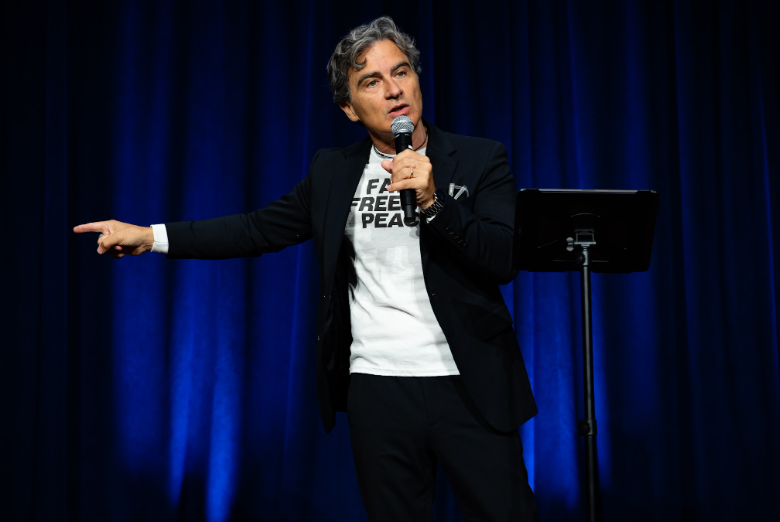
New Yorker Hotel Grand Ballroom— September 6, 2026
Wes Morgan, some love. Thank you, Wes. Come on! You can do better than that. Let’s give him some love. Thank you, God. Thank you, God. Thank you for being with us here today, Wes. Thank you for that incredible music. Wasn’t that amazing? Should we just go back to music? Oh man, thank you so much.
And let’s also give it up for Minister Sean Pennington for showing up in the house, showing Mother some love. You may not have seen his face many times, but this man has been working behind the scenes and with our team way back. So let’s give him some love. And to his wife, thank you for coming here together. Bless you. Thank you, thank you, thank you, Dr. Jenkins, for a beautiful prayer and reminding us that this is a global, cosmic work. God’s working with Mother on a cosmic level. Thank you for your prayer. Let’s give it up for Dr. Jenkins. He’s been working so hard to get Mother out, and I know he doesn’t like being pointed out too often.
But we’ve got Curtis Farrow in the house. And by the way, if you want to know, he does love hugs at the end of the show, if you’re a hugger! All right, please be comfortable for a minute.
Thank you, guys. Thank you so much for being here. Thank you for those watching online. Thank you, God. Thank you, Jesus.
I just want to breathe in the spirit for a minute. I just want you to know: God really loves you. God really loves you. And I believe God is calling us right now to a higher place. You want to say, “Higher place”? I believe Jesus is calling us to a higher place, not a lower place. I believe Jesus is calling us to a higher ground today—a higher ground.
The only requirement is that each of us is willing to change a little bit. Just a little bit. If each of us is willing to change a little bit, then we will be able to be elevated up to a higher ground. You want to go to a higher ground?
So we heard the Word already from Sean, because I believe it is written. Jesus called us to this place once before, up a mountainside. And we read in Matthew 5, as Sean mentioned, this incredible manifesto for the Kingdom of God, for the Kingdom of Heaven. And Jesus is speaking to the peacemakers. Anybody want to say, “Peacemakers”? Who are we? We are the peacemakers.
You know, Jesus was giving a blessing. Jesus was giving guidance. Jesus was encouraging, and Jesus was also giving a warning. But He was laying out the way for us to follow. He was calling on us to be peacemakers. And I don’t want to think of it in the past tense. He is calling us to truly be peacemakers—real peacemakers.
Like Sean pointed out, we’ve got to be ready to go into uncomfortable places. We’ve got to be ready to say the things that might cause others discomfort, such as the truth. Okay? We have to be willing. What are we afraid to lose if it’s for peace? Is there anything not worth sacrificing in the name of peace?
I think we have to be ready to change.
So Jesus said: “Blessed are the peacemakers, for they will be called”—what?—“children of God.” The peacemakers will be called the children of God. “Blessed are they, therefore, who are persecuted because of righteousness, for theirs is the Kingdom of Heaven.”
So if we’re willing to be a peacemaker, if we’re willing to stand up for peace—it’s too short a word for its meaning, and it’s a word that gets thrown around a lot—a peacemaker is a changemaker. And never in history is a changemaker welcomed by the ones he seeks to change. Especially when you want to make a big change.
When you want to make a big change, a big changemaker is going to cause all kinds of discomfort for those who don’t want to change. So blessed are they. Because it’s as if you can tell who is a peacemaker by virtue of the persecution that is upon them. But the Kingdom of Heaven shall be given to them.
So, would we rather be comfortable, keeping peace at bay, keeping things as we want them to be for us? Or do we want to change and rise up to a higher ground and be a peacemaker for the inheritance of the Kingdom of Heaven?
And then further, Jesus goes on to say: “Blessed are you when people insult you, persecute you falsely, and say all kinds of evil against you because of Me.” Blessed are you for doing so in My name, in God’s name. Blessed are you if they persecute you. Blessed are you if they insult you and say all kinds of falsehood against you. Be blessed.
So how do we recognize a peacemaker? Because we can wear the T-shirt—and, by the way, we’re selling them. They’re available online. Anybody is welcome to wear the T-shirt. That’s easy. God bless you. But how do we recognize a peacemaker? Jesus gives you the key to this also.
Jesus also teaches us to discern people by their fruit; I believe that principle helps us recognise peacemakers. For Jesus says, “You shall recognize them by their fruits. You shall know them by their fruits.” By their fruits, you shall know the peacemakers—not only by virtue of the persecution that may befall them, but by the very works, by the very fruits of their work.
So what does the fruit of a peacemaker look like? All right. I want to introduce you to a peacemaker that’s very near and dear to my heart. Is that okay? Let me introduce you, therefore, to someone I believe to be a beautiful peacemaker—a beautiful peacemaker.
I believe the most beautiful peacemaker in human history. Her name is Dr. Hak Ja Han. She’s 83 years old, and millions around the world know her, respect her, and love her as the Mother of Peace. Currently, she is being detained by South Korean authorities. But this is not the first time she’s been detained.
The first time was when she was six years old, captured and detained by North Korean authorities as she and her mother and grandmother were seeking freedom and trying to cross the 38th parallel into the South.
So I think it wise to reflect for a minute on where this child comes from. Is that okay? I want to spend just a minute. Where does the Mother of Peace come from?
She was born in 1943 in what is now North Korea. Her father named her Hak Ja, which translates into “crane child.” The crane is a symbol. He had a vision of two cranes dancing upon her and named her “crane child,” because the meaning of the crane in Korea signifies beauty, longevity, and peace. Her name translates essentially into “child of peace” or “daughter of peace.” Daughter of peace.
This was a family that attended God not just on Sunday. This was a family that attended God as if God was in their home. They attended Jesus not only in their prayers, not only on their way to church, but in their home, 24/7. I’m saying they cooked food for Jesus in their household. I don’t know how many of you all have been cooking food for Jesus! Sewing clothes for Jesus. This is how they attended God. This is how they attended Jesus in their household—with a longing heart. A longing heart. This family came out of a period of colonization of their country, where they were standing up, risking their lives—for what? For freedom.
By putting their faith front and center, longing for their nation to live in freedom and peace. And they attended God as such. They prayed to God as such. They believed in Jesus as such—with a longing, expectant heart, a fiery heart, as if Jesus was right here. Not “as if.”
And her favorite memory is simple. Hak Ja’s favorite childhood memory was holding her mother’s hand on her way to church. Mother’s favorite childhood memory is walking to church holding hands with her mother—not just being at church—because she felt God in the hand of her mother. She felt God on the way to church. She felt God in the flowers on the roadside on the way to church and on the way back from church.
She felt God in her home. She felt God in her life. And she recalls relating to God as her Father. “God is my Father.” She knew her identity—not just as a child of peace, but as a child of God. A peacemaker from birth. A child of God. This was her identity. I am God’s child. I am God’s daughter. She knew nothing else. She didn’t imagine it any other way.
And when people ask her, “How is it that you came to find God? What life-changing event? Where did you go to school? What did you study to find God?” How would a baby find its mother’s bosom? The most natural way. This is her experience with finding God. So she actually cannot remember finding God. All she remembers is growing up in an existence in relationship with God: God is my Father. I am God’s daughter.
And it occurred to me this morning that there must have been a period of time in her young life when she assumed this would be the same for everyone. But we know that isn’t the case. This is the purity with which she grew.
Persecution came early in the life of this child of peace. When she was an infant, her mother had many dreams—especially one dream she recalls when Mother was just a baby. The devil came to her mother in her dream and fought with her, pushing her back, sweat pouring out of her. And she tells of the dream, that the devil was tricking and deceiving and telling her: “I will take your child. I will take your child’s life. She will be mine.” And the mother, in her dream, fought back against the devil. This is a real life-or-death dream.
Later, an angel appeared to her and told her that she must protect this child. You must raise and protect this child for her assignment, for she has an assignment from Heaven. She has an assignment from Heaven, from her Heavenly Father. And your job is to raise her, to protect her as if she were God’s child. This is how this young girl was raised.
At this time, the North is turning communist. The North of Korea is turning red. They are organizing themselves, and they have an agenda. And their agenda is not peace. Their agenda is power, and they don’t want anybody else to have that power. So they want to take over the South.
And at just five years old, her mother and grandmother were jailed. What for? It was a dangerous thing to have faith. It was a dangerous thing to ask for freedom. It was a dangerous thing to pray or speak of peace in North Korea in those days.
So her mother and grandmother were jailed. But little Hak Ja, five years old, went to the jail every day to visit. And she was so polite, and so sweet, and so pure that she melted the guards’ hearts. The soldiers’ hearts were melted by this little girl, and they would give her fruit and they would give her candies.
Eventually, her mother and grandmother were freed. But the clouds of war were looming in North Korea at this time. This is the world she was growing up in. The clouds of war were looming. You knew it if you were there. You could smell it in the air. War was on its way. They needed to escape.
So at age six, she fled the North to go to the South together with her mother and grandmother. For a minute, if you can imagine: a grandmother, a mother, and a six-year-old little girl, alone, traveling over 250 kilometers through muddy marshes at night so as not to be seen. And finally, when they got to the border—I mean, how do you cross a border? Do you think the border is like a line?
It is a long stretch of land. Just to get to the border, there’s a north side of the border, and then there’s a lot of no-man’s-land, and then there’s the south side of the border. And this is an environment where soldiers on the North and soldiers on the South are instructed to shoot anyone who tries to cross. Shoot to kill on sight. That’s the only thing that the two armies were completely united on—to shoot anybody who crosses that land.
They get to the border, and they are captured and detained, along with others who had risked their lives coming close. Even just getting close: “What are you doing there? Where are your papers? Why are you out of your village?”
They get locked up, and you don’t know what’s going to happen to them. But again, young Hak Ja—oh my God, she was so cute and beautiful. If you see the pictures, I mean, six years old. I don’t have a picture of her at six, but she was so beautiful. She was very cute. And she’s going over to the guards and melting their hearts. And the guards let these three ladies go, as long as they go back home to the North. So now they’re out again.
Do they go north? Do they go back home, where there is no room for faith, no freedom to bring peace? No.
Quickly, they find someone to take them back across the border in the dead of night. The dead of night. And as they’re crossing the border, Wes, the South Korean soldiers hear them. Rifles through the bushes. But they hear the sound of a little girl’s voice singing. Because young Hak Ja, as she’s holding the hands of her mother and grandmother, crossing the border, is singing a song. I mean, I’d be quiet! I’d be really careful. But she’s singing songs of freedom. She’s singing songs of freedom.
And it’s because of those songs, because of that little voice, that the soldier who was ordered to shoot to kill took his finger off the trigger, lowered the barrel, and waited to see these three women coming his way. God was there. God was there.
No North Korean border can stop the Daughter of Peace. No South Korean border can stop the Daughter of Peace. No barrel of a gun, no soldier, no police can stop the Daughter of Peace singing songs of freedom. Not for herself.
This is a young girl who is dreaming for faith and freedom and peace for humanity. This is a little girl who’s slowly beginning to open her eyes to the wider world and really see what’s going on. This is a little girl who’s confronted with evil from a young age. She does not need to go to school to understand God, nor evil and how it works. And as they’re crossing, they find this soldier. Not only does he lower his barrel, but he pulls out all of the money in his pocket to give them, to help them make their way free to Seoul.
But I think there was a particularly defining moment that I want to share, because it was only a few months later. She’s now seven years old, and the Korean War breaks out. It’s June 25, 1950. They’re living in Seoul, which is not too far from the border. When the war breaks out, the South is completely disorganized. The North Korean Army is coming down like thunder, and it’s time to flee. It’s the only thing you can do.
There’s nobody—the soldiers are not enough to defend. This is before the UN comes in. We’re talking about the North coming down to crush the South, and they’re on their way to Seoul. And so the three ladies get out of their home, and they start to rush. They have to run. They have to cross the Han River. They have to get to the one bridge nearby and cross the river to make it to the South, so that they can keep on running and not get locked in by the river and destroyed by the soldiers coming their way. This is what’s going on.
But as they’re walking to the bridge, the mother receives a revelation: “We have to go back.” We have to go back—against the crowd. She goes against the crowd, back to the room where they were staying, because she had a revelation that her brother would come in an army truck to pick them up. And this is what happened.
The brother shows up in a truck and puts all three ladies in the truck. And then they make their way back, with the mother holding Hak Ja in her arms, cradling her in her arms. And the truck is making its way through the crowd. You’re talking about hundreds, thousands of refugees now trying to cram onto this bridge. And young Hak Ja’s uncle is driving this truck across the bridge. Okay? Through the crowd, Wes. Through the crowd. This is a movie scene.
She’s crossing the bridge, and you don’t know what’s going to happen. The only way to stop the soldiers from coming into the South is going to be to blow up the bridge. The South has to blow up the bridge to stop the soldiers making their way to the South. But what should we do? We have thousands, tens of thousands of our people trying to get across. What can we do? That truck is right in the middle of the bridge as they’re contemplating the timing of this explosion. They just make it.
They get to the other side of the bridge, and immediately the truck shakes with a bang and a boom and a flash of light in the sky. And you’re young Hak Ja. You feel your mother holding you, but the whole truck shakes. And the uncle shouts: “Quick! Get out!” And he sends them down into a ditch by the side of the river on the south side. And again, a huge blue flash in the sky. Another explosion. This is Mother’s testimony. Seven years old.
She looked back and witnessed another explosion. But what she witnessed was civilians and soldiers and police who were still on the bridge being thrown into the air. Excuse the graphics. They were thrown into the air and into the river. This is what she saw. She realized that it was just a few meters, a few feet, a few yards between death and survival. Her family escaped that explosion by just a matter of a few yards. And she’s this young girl, crouched down in a ditch, probably smelling the soil of the embankment. Can you imagine the sound? The smell in the air?
And she looks up to a bridge which is now smoldering, and she asks herself, with her eyes closed: “Why would anyone start a war?” “Why did innocent people have to die?” And then, with a resolve, she asks herself: “Who can bring an end to this madness?”
These are her thoughts in her childhood. Who will bring an end to this madness? And when she opens her eyes, the bridge is gone. And she says: “I was only seven, but I became so serious that war has to vanish forever from this world.”
Still today, when she crosses the Han River, those images come back to her. Imagine walking your entire life with these types of memories—with that conviction: Who will bring an end to this madness? Who will bring an end to this madness?
“I was only seven, but I became so serious. I became so serious that war must vanish from this earth. War must vanish from this world.” This is a seven-year-old little girl. What girl? A daughter of God. A daughter of peace.
This, I believe, is when she made her determination to become the Mother of Peace. Is it okay to testify to her that way? I believe, if I look at her own testimony, it must have been seven years old. Surely by seven years old, she was understanding the severity of the challenge and taking on the mindset that this must end. And so what does that language suggest, other than the mind of someone who’s about to take responsibility? Wes, you understand?
So let’s look at her fruits. Because this is why she has dedicated her life to faith, to freedom, and to peace.
We don’t have time to go through all of the things she has done—beyond race, beyond religion, beyond creed, beyond every man-made border that we’ve been able to build up, brother against brother. She looks over those walls. She sees beyond the discomfort. And she truly sees a world of peace that’s worth fighting for.
Together with her husband, she married not just young couples, but young couples from enemy nations—as a condition, as an offering, as a desire, as a prayer to God: “God, Heaven, if with this You can do mighty works, if with this we can do greater works in the name of peace—to bring enemy children together—how can the grandparents continue to hate their grandchildren?” Genius.
She brought religious and civic leaders together in the name of peace. She gathered leaders of nations together in the name of peace. And isn’t it interesting that Jesus said the peacemakers would be called the children of God?
Because this little girl grew up spending her life telling the world exactly that: God is our Heavenly Parent. We are God’s children. And if God’s children are we, then somehow, can we not build a world of peace by treating one another as brothers and sisters? But perhaps this one more story says it all, Curtis, because it broke her heart. She says, “It broke my heart that the atrocities connected to slavery were done by people who prayed in the name of Jesus Christ.”
That the atrocities done in connection to slavery were done by people who prayed, meanwhile, in the name of Jesus Christ. This is a false association with Jesus. This is not Jesus’ will. This is not Jesus’ heart. Jesus would not lead a people into a continent to take. This has been heavy on her heart. Heavy on her heart, as if it would be her life mission to liberate Jesus—to liberate Jesus, to liberate God.
So where does she go with this? Where does she go with this? She went to where history still hurts. Sean, this is just one story. She goes to Gorée Island in Senegal, a place where history still hurts. It’s dripping off the walls. It hurts.
She went to the House of Slaves, where men and women and children were housed, made ready to get onto boats, to be packed onto boats. This is called the House of Slaves. Mother went into the cells. She touched the walls of the cells. She walked through the cells. She looked at the place where they slept in agony, awaiting the dreadful moment when they would go through the Door of No Return. There was a door that looked out onto the ocean from the House of Slaves. This doorway is called the Door of No Return. She looked at that door as they would have looked at that door. And she went to stand in the doorway and wept. She stood there, and she wept and wept.
And she prayed. She prayed for the victims and the descendants of slavery, and for Africa’s liberation from that historical pain. Who does this? Who does that?
Personally going there—aside from the money she donated, and the boats she gave, and all the other works, and the youth she sent—her heart, Sean. Her heart. Just to even care about this thing, to see the points, to connect the dots, and to go to the most painful place and to simply pray. To put herself there and to ask God forgiveness. Forgiveness.
It’s as if she’s asking God, for God’s sake, and she’s asking for Jesus’ sake, to liberate. How can God feel joyful with humanity in pain? She’s longing to liberate the heart of God, longing to liberate the heart of Jesus. For how can people do this in His name? She’s longing to clean that up—not to point fingers at it, not to accuse it, not to persecute it, not to take it to court, but to liberate it. To be there. To be there as someone who had nothing to do with this, but herself going there as a daughter of God, going there as a Mother of Peace, asking God: Please forgive humanity.
And praying for humanity: Please, please come together as brothers and sisters in peace.
I tell you, a peacemaker does not look away from the wounds of history. A peacemaker does not look away from the uncomfortable areas. A peacemaker goes there and prays for healing. This is who she is.
How will you know what a peacemaker looks like? You shall know them by their fruits.
And she did this in countless other places. This is what the Mother of Peace has continually done. So Jesus said, “By their fruit, you will recognize them.” And this is her fruit. This is her fruit. And this is why she is known around the world as the Mother of Peace. This is not a brand name. This is an identity thing.
She’s never known anything but being a daughter of God, dreaming of a world of peace, committed to giving her entire life to it, at great risk to her own life and anyone else. She is doing it for God. And when you’re doing it for God, and when you’re doing it for peace, and you’re not just thinking about your people, but you’re thinking about all people, then what other kind of heart is that than a parental heart?
And hasn’t humanity longed for the motherly love of God through a Mother of Peace such as her? Wouldn’t it look like a beautiful gift from God? Aren’t we blessed to have such a gift from God? Aren’t we blessed to have such a gift from God—the Mother of Peace? So where is the Mother of Peace today? Can I get real? Where is the Mother of Peace today?
It is 482 days today—482 days today—since the Mother of Peace was put on a travel ban. And then a thousand-man raid. A simultaneous raid on all of her churches, all of her offices, her most precious, sanctified places of prayer. Wes, we’re talking about police boots trampling on floors where we take our shoes off to pray. Unheard of, by the way. Before you think, “Oh, that’s normal,” it doesn’t happen like that.
Simultaneously, other Christian organizations and churches were being trampled on. Husbands and wives pulled out of their bedrooms, belongings dashed to the floor. What were they looking for? Who were they trying to protect?
It’s been 482 days since this started for her. A thousand-man raid, then interrogation, then an indictment, then a jail cell the size of a Mini Cooper. You can fit it onto two of these squares of the stage. And this is an 83-year-old great-great-grandmother.
We have her granddaughter with us today. Shinyuh, please stand up and be recognized. This beautiful, beautiful granddaughter of peace. And I tell you, this young lady shared some things with me the other day that all I can describe—her words are like a little flower in my heart. I feel like I’m in the middle of a storm, and it’s like my job to protect that little flower. That’s what I feel. Thank you, Shinya.
This lady’s grandmother, at 83 years old, can barely walk. She can barely see. And after falling down multiple times in a dark, damp cell, she had to resort to crawling around this tiny space on her hands and knees.
We’re talking about the Mother of Peace, who’s never even had a parking ticket, has served the entire world her entire life, reduced to crawling around a cell the size of a Mini Cooper. For what?
To the point where she was hospitalized. She’s been now in hospital, what, five months plus? And then finally, the final hearing. The prosecutors ask for 13 years. They want her to stay in there until she’s 96 years old. This is serious.
The judge, on the final ruling, appears lenient, recognizing her global peace work. This is a woman that has been accused of everything and guilty of nothing. Accused of everything and guilty of nothing. And the prosecutors are asking for 13 years. It’s going to look bad if you just let her go home now after spending how much money?
Am I saying it too strong? They want her to stay in there until she’s 96. That’s not right, guys. Like I said last week, I didn’t need a travel ban to know something was wrong. I didn’t need a thousand troops in her sanctuary to know something was wrong. I didn’t need an indictment. I didn’t need a sentencing. I didn’t need any of this to know that something is wrong.
And so the judge has given her two years more. And what do the prosecutors do? They appeal. The prosecution appeals. They’re dissatisfied. They want more.
Why hasn’t this peacemaker suffered enough? Hasn’t this peacemaker suffered enough? Let me ask you again: What would Father do? What would Father do? Would he wait to see what the judge says next?
You know, look. Let’s be real. There are certain things that are outside of our control. What we can control is what we do, what we say, where we go—right here in the United States of America, where we do have the freedom to do so. Right?
If we have the freedom, then we have the responsibility.
And here’s the thing: I know she’s not in there praying for herself. I know she’s not in there praying for her release. She’s praying for us. She’s praying for the world. She’s hoping that righteous people will come together and stand up for faith, freedom, and peace. She must be in there right now hoping that at least this might be a signal to the people of peace around the world to stand up for faith, to stand up for freedom, and to stand up for peace. I believe so.
This is what she has risked her life for. Why would she stop now? She’s been there before. Why would she stop now?
But the question is: What will we do? And this is where I want to bring it home. What will we do?
I tell you, if we want our freedom, if we want our peace, then we have to do something. We can preach about peace. We can wear the T-shirt. But if we truly want peace, then we have to stand in our faith, and we have to fight for our freedom.
Faith gives birth to peacemakers, doesn’t it? It is our faith that gives birth to peacemakers, and freedom gives us the space to work, and peace will be the fruit of that work.
But we can’t stand down when we are tested. We have to stand up now. For those of you who don’t know what I’m talking about, I’m talking about this: We cannot be quiet anymore. We Unificationists, first, cannot be quiet anymore.
And to the broader community: religious freedom cannot exist just for one group, but only by protecting all people who believe in faith—all people who believe in freedom and peace. Isn’t that so? Isn’t that so? That means we, too, are being called to stand with others who are in trouble. Isn’t that so?
If you’re wearing that T-shirt, that’s what that means. I am calling on all believers now. I’m calling on all believers. Help me. Help me. Let’s reach out to all who believe. Okay, let’s put our politics aside, our doctrine or our theology aside. I mean, God is God. Spirit is Spirit. Jesus is Jesus. We can say all of these things and still work against those things. We can believe in all of these things, but still work against these things.
We must be careful to be of God, with God, with Jesus, with Spirit, in all that we say and all that we do. And for God’s sake, what would we be afraid of? What is there to be afraid of? Isn’t Jesus calling us to a higher ground, or is Jesus calling us to a lower ground? Is Jesus inviting us into a safe place? Is Jesus inviting us up to a middle ground? I believe Jesus is inviting us up to the higher ground. I believe Jesus is inviting us up to the highest ground.
How can we allow the Mother of Peace to suffer like this any longer? So you say, “What can I do?” But hasn’t this peacemaker suffered enough? So here’s the thing. This is my point. We don’t ask them to let her go because she needs to be free. In truth, this is a woman who is already free. The challenge is on us.
This is a test of our own faith. This is a test of our own freedom. This is a test of whether or not we are willing to face the discomfort to stand for peace. This is a test on us. We need to stand up as a matter of our own faith. We need to stand with her for the sake of our own freedom.
Are you hearing me? You might think that your prayers, and your showing up, and your shouting and screaming are going to have the effect of freeing her. But it is we who need to be free. We need to be free first before our prayers will have power.
And in order to be free, you have to exercise that freedom and go out and speak the truth. And the truth is, I didn’t need a travel ban, an indictment, or a thousand police mocking her to know that something’s wrong.
I say it’s time to let her go. I say enough is enough. We need to stand with her for the sake of our own freedom. We need to speak the truth to protect peace. And we have to say out loud that the Mother of Peace has suffered enough, and it’s time to let her go.
It’s time to let her go. It’s time to let her go for the sake of faith.
Come on, get on your feet! It’s time to let her go! Can I hear you say: “Let her go!” Let her go!
For the sake of freedom: Let her go! For the sake of peace: Let her go!
For the sake of humanity: Let her go! Do you feel it? Do you mean it?
Do we want her to pay any more price? Do we need any more proof that something’s wrong? I am asking all believers to stand up—to stand up with the Mother of Peace. Because if you stand up with her and for her, God will do miracles.
If we’re going to chant anything, then let’s chant: Let her go! Let her go! Let her go! I can’t hear you! Let her go! Let her go and be free! I want you to be free to shout it louder! Let her go! Let her go! Let her go!
Dear God, Heavenly Parent, we thank You. We ask that You can really cover the Mother of Peace today. We ask that You can cover her family members, her leaders, and her members around the world who are praying for her, fighting for her. We’re asking all believers to stand up in the name of peace, to hold hands in the name of peace, to stand together in the name of peace for the Mother of Peace that You have sent to bring us together, to bring us back home.
God, it is not right that she be treated this way. It is not right that she be treated this way. We don’t need to get into the politics. We don’t need to get into the legalities. This is a woman who is guilty of nothing, but accused of everything. This has happened to all the great peacemakers, all the great changemakers.
God, we are with You. Jesus Christ, we are with You. True Parents, let’s do this. And let us take responsibility to bring about their dream—to bring about Your dream, God.
We ask all of this in Jesus’ name. We ask all of this in our names, attending Holy Mother Han. Amen. Aju. Aju
